Societies around the world are becoming increasingly diverse, partly because of immigration. In many countries, this change has been accompanied by backlash against immigration and growing racial, ethnic, and political divisions. My research examines why differences between groups sometimes lead to conflict and exclusion, while at other times they create opportunities for cooperation and solidarity. My work spans the United States and Europe and contributes to broader debates about immigration, inequality, intergroup cooperation, and democratic inclusion.
Trust, Cooperation and Conflict
Central Question: How do racial and ethnic groups build cooperation across social and political boundaries?

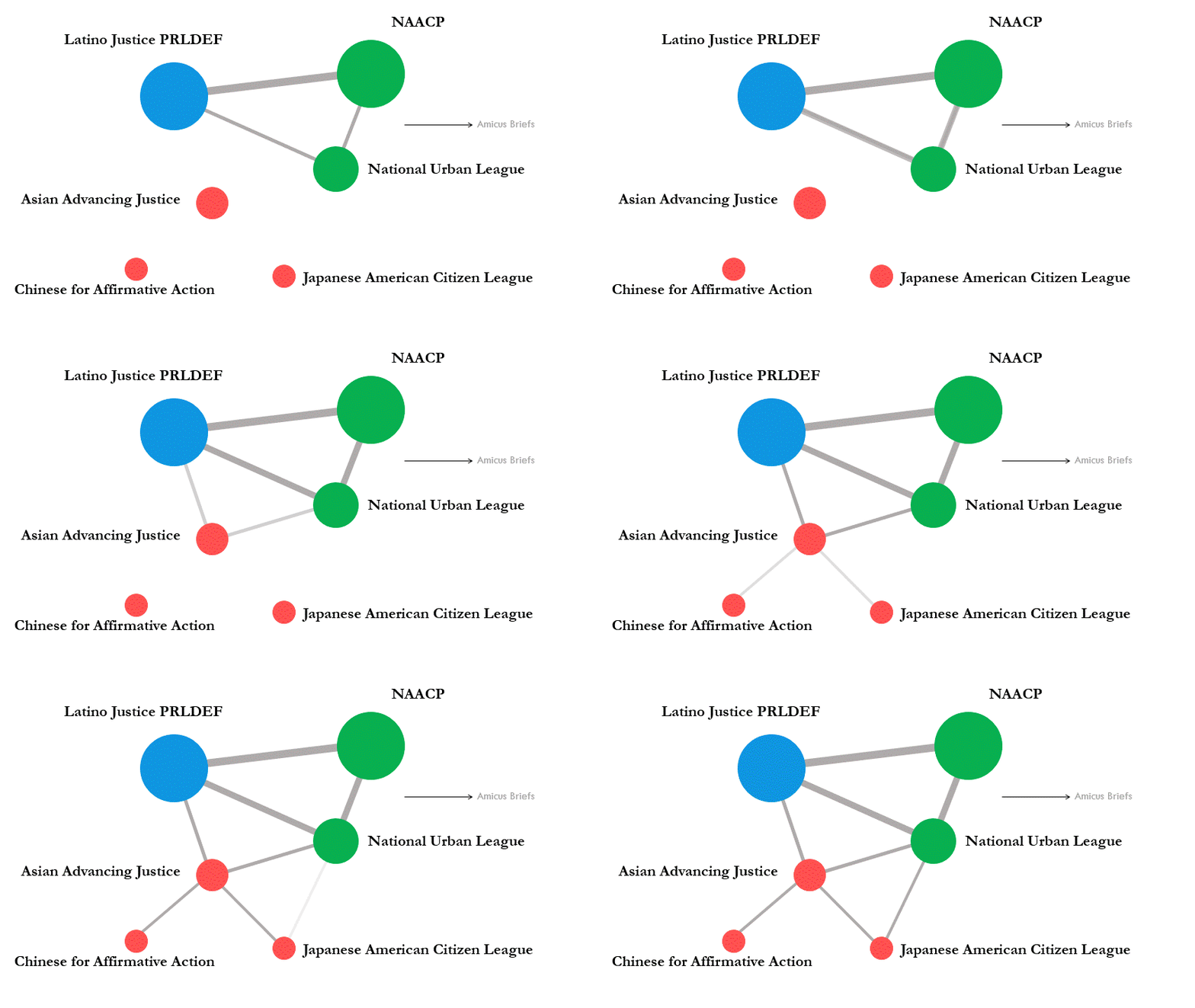
Racial and ethnic relations are often understood through the lens of competition, prejudice, and conflict. Yet groups also cooperate, form alliances, and mobilize around shared political goals. My research examines the conditions under which intergroup cooperation emerges, how it is sustained, and why it sometimes breaks down. I investigate these questions across multiple levels of analysis.
At the organizational level, I examine how racial and ethnic advocacy organizations navigate competing interests and opportunities for political cooperation. At the individual level, I use behavioral experiments to investigate how social identities, perceived threats, and group composition shape trust and cooperation. Together, these projects seek to advance a more relational and dynamic understanding of racial and ethnic relations, one that accounts for both the possibilities and limitations of solidarity in diverse societies.
Figure 1. Amicus Brief Network of Organizations.
Citizenship, National Belonging, and Racial Boundaries
Central Question: Who belongs to a nation, and what determines whether immigrants and their descendants are recognized as legitimate members of society?

Although citizenship formally establishes political membership, the boundaries of national belonging often extend beyond legal status to encompass racial, ethnic, cultural, and social distinctions.
My research examines how these boundaries are constructed, negotiated, and transformed in increasingly diverse societies. I am particularly interested in the relationship between formal citizenship and social recognition, the characteristics that shape perceptions of national membership, and how immigrant populations navigate competing expectations of belonging.
In one study, I use conjoint experiment to examine how characteristics of immigrants shape public judgments about their eligibility for legal citizenship and their recognition as American (cultural membership). The findings demonstrate that the characteristics influencing legal membership differ from those shaping perceptions of national belonging. This distinction highlights the importance of examining citizenship as both a formal legal status and a socially constructed boundary of inclusion. It also reveals how racial, ethnic, and cultural distinctions can continue to shape national membership even when formal legal requirements are satisfied.
Racialization, Discrimination, and Minority Mobilization
Central Question: How do racial and ethnic minorities experience, interpret, and respond to discrimination and exclusion?
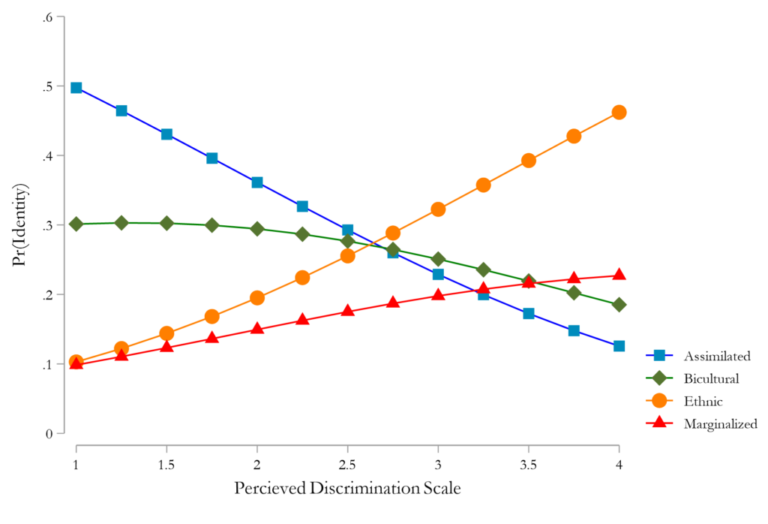
Figure 3. Perceived Discrimination by Identity Patterns.
Although racial inequalities are embedded in broader institutional and structural arrangements, their consequences are also shaped by how individuals understand their social position, interpret interactions, and navigate relationships with other groups.
My research examines the social and relational processes through which racial boundaries become meaningful in everyday life. I am particularly interested in how immigrants and racialized minorities interpret experiences of discrimination, how these interpretations vary across social contexts, and how experiences of exclusion shape identities, incorporation, and political engagement. This work contributes to scholarship on racialization and inequality by highlighting how discrimination and minority responses are shaped not only by individual characteristics but also by intergroup relations, social comparisons, and institutional contexts.
In one particular article, my co-authors and I examine patterns of perceived discrimination among South Asian Indian immigrants. We develop a “relational framework” which allows scholars to examine how perceived discrimination is often interpreted both contextually and relationally. We further argue that this type of relative evaluation reflects and further reinforces existing systems of racial stratification where anti-Black distancing plays an essential role in how South Asian Indians try to fit in within the larger American Black-White divide. This paper was published in Social Psychology Quarterly(2023).
Ethnoracial Diversity and Immigrant Incorporation in Europe
Central question: How do immigrants and their descendants navigate social, cultural, and political incorporation across European societies?
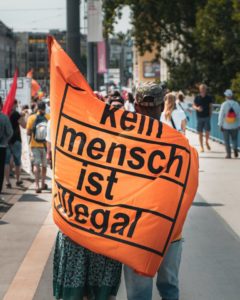
European societies have experienced profound demographic and political transformations as immigration has increased ethnic, cultural, and religious diversity. These changes raise important questions about how immigrants and their descendants become incorporated into receiving societies, how identities and attitudes evolve across generations, and how national contexts shape these processes. My research examines immigrant incorporation in Europe, with particular attention to the role of families, social identities, and institutional contexts in shaping social and political integration. Rather than treating incorporation as a uniform or linear process of assimilation, I investigate how immigrants and their descendants navigate competing expectations, maintain or transform cultural orientations, and develop attachments to their societies.
Building on this work, my future research will examine how changing political contexts and debates about immigration reshape the boundaries of belonging, minority political engagement, and opportunities for intergroup solidarity across European societies